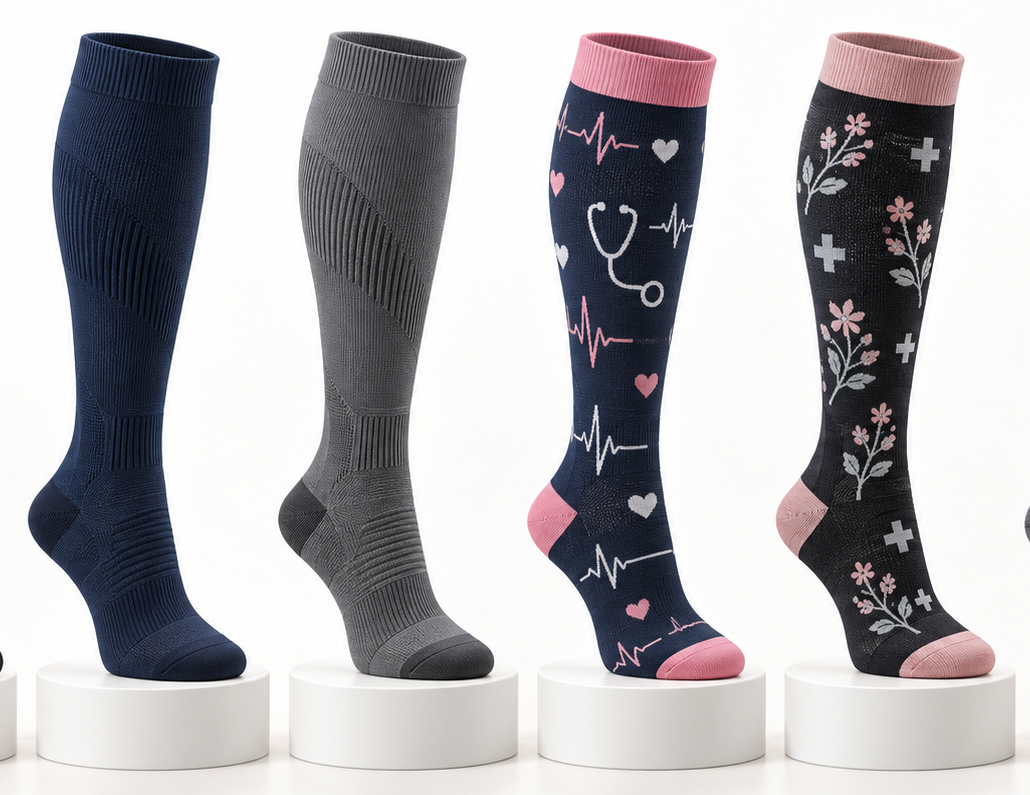
1. Start with the intended product, not only the number
State who the product is designed for, how it will be sold, and which destination market will receive it. A travel retail program, sports collection, nurse uniform range, and specialist channel may use different constructions, sizes, materials, packaging language, and documentation even when a pressure range appears similar.
The manufacturer can develop to the buyer's requested program, but the buyer remains responsible for validating market claims and any medical, regulatory, or professional requirements with the appropriate specialist.
2. Connect the pressure target to construction and sizing
Compression is created by the finished knit structure, elastic behavior, shape, and size—not by a label alone. The cuff, calf, ankle, heel, foot, and toe must work as one product. A size system that changes without reviewing the construction can also change how the finished sock performs and feels.
Include the target pressure range, size architecture, wearer profile, material direction, and any reference product in the same brief. This gives the development team a better basis for sample construction.
3. Agree on the test and acceptance route
Before ordering, specify whether the program requires a particular test method, report, laboratory, sampling plan, or buyer acceptance record. Do not assume that every pressure claim, market, or product category uses the same procedure.
The agreed route should identify which size and production stage will be reviewed, what documents are required, and how results will be linked to the approved specification. This is especially important when the packaging or product page will display a numeric pressure range.
4. Review the physical sample as a complete product
The sample review should cover more than the pressure target. Check donning experience, cuff position, calf and ankle zones, heel placement, toe comfort, overall length, material feel, opacity, pattern appearance, and size communication. Confirm that the sample being evaluated uses the intended construction and material.
If changes are made after testing or fit review, record them and decide whether the updated version needs additional verification before bulk production.
5. Build a complete compression-specification RFQ
A clear RFQ helps the factory distinguish a stock route from a new OEM development route and quote the correct sample and production plan.
- Requested pressure range and intended sales market
- Target wearer, use case, sizes, and estimated quantity
- Material, color, logo, pattern, and packaging requirements
- Required test method, report, label claim, or documentation
- Reference product, sample deadline, and launch date
Bring the brief
Ready to make it sample-ready?
Share the requested compression range together with the wearer, size, material, market, and verification requirements. We can then define the construction and sample route that should be approved before bulk.