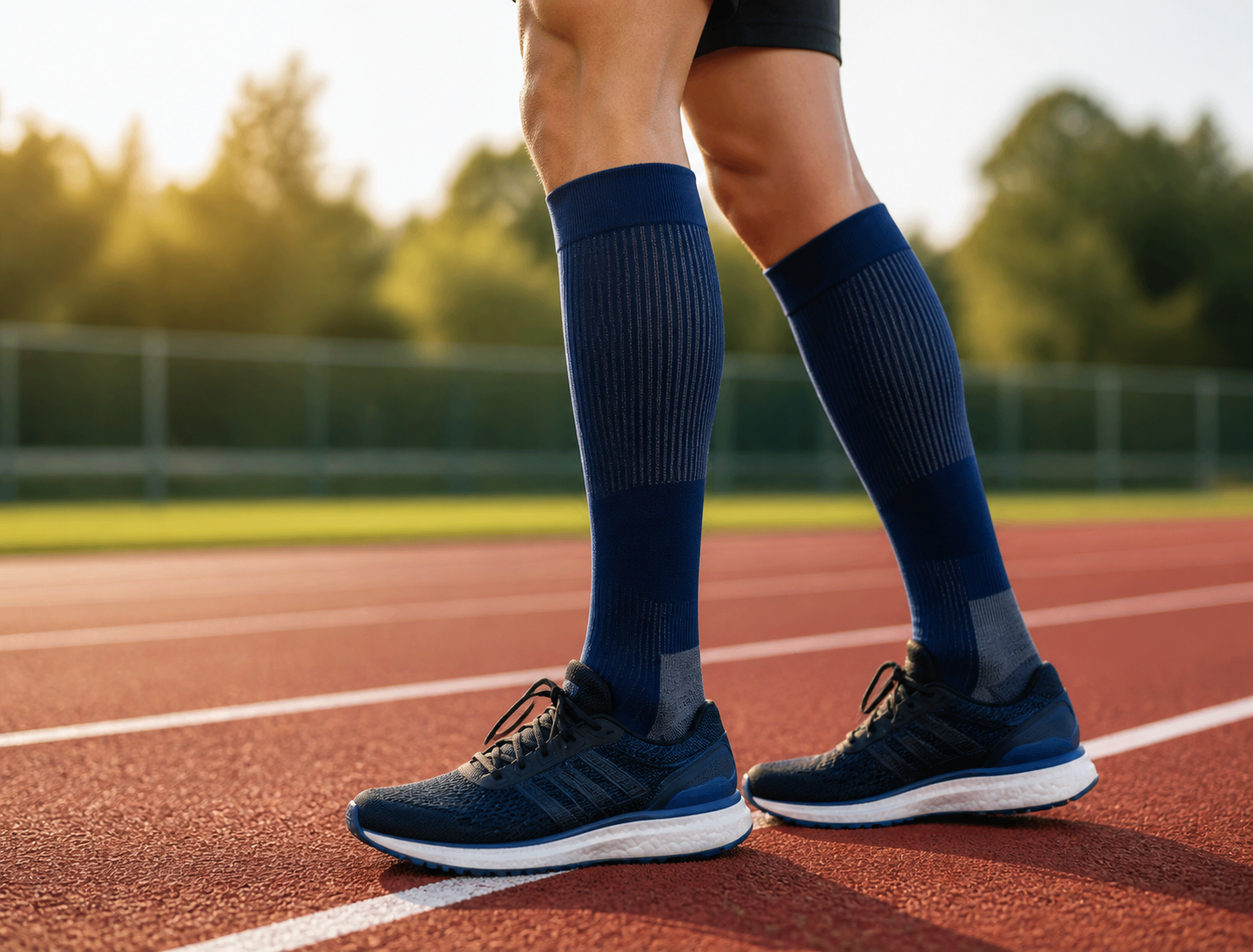
1. Define the sport and wearing context
Running, gym training, team sports, outdoor use, recovery-focused retail, and active lifestyle collections can require different lengths, cushioning directions, ventilation, yarns, colors, and footwear compatibility. Describe the real use case and the experience the brand wants to deliver.
Avoid relying on broad claims such as ‘performance’ or ‘recovery’ without defining what the product is designed to do and how the buyer will support the claim in the intended market.
2. Map the construction zones
The brief can identify cuff position, calf and ankle support, arch treatment, heel and toe reinforcement, cushioning, ventilation, and seam preferences. These zones need to work with the requested compression program and size range.
Graphics should respect those zones. A large logo or color block may distort or interfere visually when placed over a denser area, so construction and artwork should be reviewed together.
3. Select materials through sampling
The stock route uses a declared 65% nylon, 30% polyester, and 5% spandex blend. Custom COOLMAX®, merino wool, or bamboo fiber directions can be developed with buyer-approved ratios. The best route depends on season, activity, hand feel, care, price, and the claims the buyer intends to make.
Evaluate the material in the finished sock for stretch recovery, opacity, surface feel, moisture-related expectations, color appearance, and response to the approved care procedure. A fiber name alone does not prove the final product experience.
4. Build a usable sports size system
Confirm foot length, calf accommodation, cuff position, heel placement, and the relationship between sizes. State whether the product will be worn with running shoes, boots, training shoes, or other footwear.
Make the size guide easy to find on packaging and product pages. If multiple sports styles share one size system, verify that the approved construction supports that shared communication.
5. Review the sample in the intended context
Approve construction, fit direction, support-zone position, material, logo, pattern, color, and packaging. Record the test and wearer-review method the buyer wants to use and link the results to the exact sample version.
- Activity, wearer, footwear, climate, and sales channel
- Compression direction, construction zones, and sizes
- Material, color, logo, pattern, and packaging
- Required tests, claims, documentation, and target date
Bring the brief
Ready to make it sample-ready?
Send the activity, target wearer, footwear context, compression direction, materials, sizes, quantity, and brand artwork. We can develop a sports compression sock brief that is ready for a meaningful sample review.